
Returning,quietly.

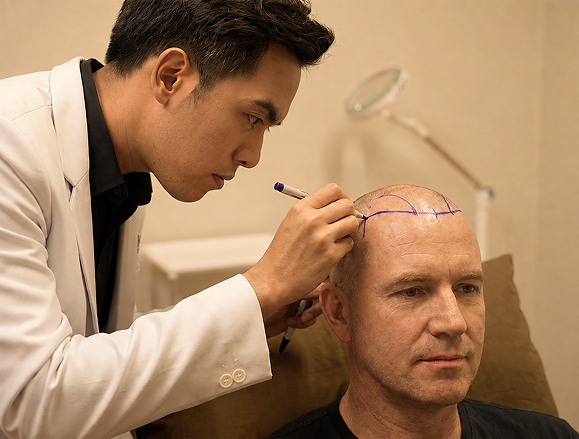
Sapphire FUE and DHI implantation for hair restoration that is impossible to detect. We design hairlines that respect your facial proportions and place follicles one at a time. Our caseload is capped at a few patients a day, each with a dedicated lead surgeon and certified technicians. The aim is hair that looks like it always belonged, never transplanted.

Overview

Hair restoration done well is impossible to detect. We design hairlines that honour your facial proportions, place follicles one at a time, and sequence donor work conservatively over your lifetime.

Treatments

The full list, with our typical price-from. Tap any treatment to expand details. Final quote is tailored after consultation.

Follicular Unit Extraction (FUE) hair transplant is a precise, minimally invasive procedure that extracts individual follicles from a donor area and implants them where they are needed most, restoring a natural-looking hairline and fullness. With no linear scarring and minimal downtime, it is one of the most advanced and sought-after solutions for permanent hair restoration.

Recovery & aftercare

Leave the donor dressing in place until your day-2 review, when clinical staff remove it and perform your first wash. Small crusts form at the graft sites and separate naturally within 7–14 days — do not pick or scratch them. Spray the recipient area with sterile saline hourly while awake for the first week, apply the prescribed antibiotic ointment to the donor area, and use a covered cold pack over the forehead (never on the grafts) to limit swelling. Sleep on your back with your head elevated about 45° for the first 7–10 days, and avoid bending, heavy lifting and straining for a week. Keep the grafts dry for 48 hours, then wash gently with a mild sulphate-free shampoo — patting, not rubbing — from day 5, returning to a normal routine from day 10. Avoid strenuous exercise, sweating, direct sun, tight hats, swimming, saunas and alcohol for two to three weeks. Resume minoxidil or finasteride only when your surgeon advises, usually after two to four weeks.

Alternatives

Non-surgical and minimally invasive options for hair loss include topical or oral minoxidil, finasteride (for men), platelet-rich plasma (PRP) therapy, scalp microneedling, and exosome therapy. These may be used on their own, alongside a transplant, or for patients who are not yet suitable surgical candidates. Medical therapy such as minoxidil and/or finasteride is strongly recommended alongside surgery to preserve native hair and protect the long-term result.

Risks & considerations

Bleeding or haematoma · Infection · Allergic or anaesthetic reactions · Swelling and periorbital bruising · Pain or discomfort at the donor site · Delayed wound healing · Scarring, raised or visible in keloid-prone patients · Poor graft survival or reduced density · Shock loss (temporary shedding of transplanted or native hair) · Unnatural hairline if poorly designed · Donor-site depletion or thinning · Graft extrusion · Cyst formation or ingrown hairs (folliculitis) · Temporary or, rarely, prolonged altered scalp sensation · Unsatisfactory result needing revision

Duration

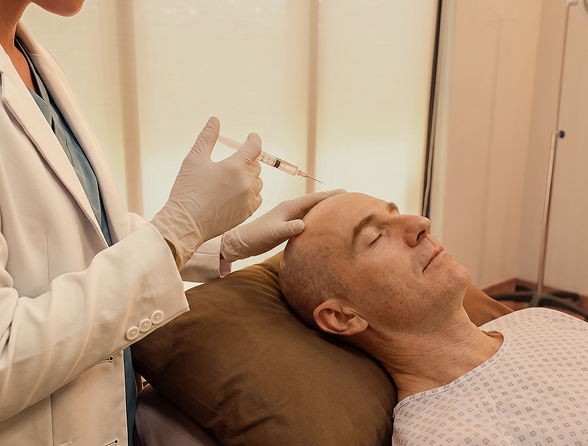
8 hours · Local anaesthetic

Recovery

10 days on-island; scabs at day 7

What's included
  • Local anaesthetic
  • Post-op kit
  • 12-month telehealth follow-up
Options & pricing
ProductUnitPrice
Bundling PRP 1x + PDT 1xAdd-onAdditional Rp 2.500.000
Bundling PRP 2x + PDT 1xAdd-onAdditional Rp 5.000.000

All prices are billed in Indonesian Rupiah (IDR), our local currency. The AUD shown is a rough reference only and shifts with the daily exchange rate.
Frequently asked

Good candidates are men with stable, patterned hair loss who have a sufficient donor area — typically the back and sides of the scalp — with healthy follicles available for harvesting. Hair loss should be reasonably stable rather than rapidly progressing. Candidates with very limited donor density, diffuse unpatterned hair loss, or certain medical conditions affecting hair growth may not be suitable. A thorough assessment including trichoscopy at consultation will determine your candidacy and realistic outcome.
Yes. Each graft is transplanted in the natural direction, angle, and density of your existing hair, and the hairline is refined by hand to ensure it complements your facial features. A well-planned and well-executed FUE result is undetectable once the transplanted hair has fully grown in.
The transplanted hairs shed within the first two to four weeks after surgery — this is entirely normal and is part of the growth cycle. New growth begins from around month three, and most of the result is visible by nine to twelve months. The full final result, including texture and density, is typically assessed at twelve months post-procedure.
The procedure is performed under local anaesthesia and is well tolerated by the vast majority of patients. The duration depends on the number of grafts being transplanted — smaller sessions may take three to four hours, while larger sessions can run six to eight hours, sometimes split across two days. Discomfort after the procedure is generally mild and manageable with standard pain relief.
The number of grafts depends on the area to be covered, your degree of hair loss, and your donor density — all of which are assessed at consultation. We provide an honest, accurate graft estimate and will not over-harvest the donor area to inflate a number. For reference, a hairline restoration may require 1,500 to 2,500 grafts, while more extensive coverage of the crown or vertex may require 3,000 or more.
With FUE, individual follicles are extracted one by one, leaving only tiny circular micro-punctures rather than a linear scar. These heal quickly and are imperceptible once the surrounding hair has grown back to its normal length — typically within two to four weeks. The donor area can be kept at any length without visible scarring, unlike strip (FUT) technique.
Yes, and it is frequently recommended. Platelet-rich plasma (PRP) therapy, derived from your own blood in subsequent sessions to support graft survival, accelerate healing, and stimulate the surrounding native hair follicles. Your surgeon will advise whether PRP is recommended as part of your overall hair restoration plan.
Your clinical team will provide detailed written aftercare instructions before you leave. In the first few days, the scalp should be kept clean and dry using the prescribed gentle washing technique. Avoid direct sun exposure, sweating, swimming, and any activity that may dislodge the grafts for at least two weeks. You should sleep with your head slightly elevated for the first week to minimise swelling. We provide telehealth follow-up as the grafts settle so your progress can be monitored remotely after you return home.
The transplanted follicles are taken from the permanent donor zone, the area of the scalp genetically resistant to hair loss, and retain those characteristics after transplantation, meaning the result is considered permanent. However, it is important to note that a hair transplant does not prevent the continued loss of existing native hair in untreated areas. An ongoing hair maintenance programme, including medication such as finasteride or minoxidil, or PRP therapy, is often recommended to preserve the surrounding hair and protect your long-term result.
Flying is generally comfortable within a week of the procedure, and the small size of the incisions means there is no significant restriction on travel. We provide comprehensive washing and aftercare instructions before discharge, and telehealth follow-up appointments are arranged to monitor your progress as the grafts settle over the coming months.
Related

Often considered alongside.

An Invitation

Begin your
journey.

A private consultation, treatment plan, and stay — coordinated as one. A concierge will reply within twenty-four hours.

Plan Your Treatment